NASA & the GBO
Thank you to Lindsey Doermann for writing this article, which was published in NASA Earth Observatory
Another remarkable aspect of the park can be experienced by looking up. One of the darkest places in the United States, the area is ideal for observing the night sky. The national park is located within the Great Basin, from which it draws its name, a large region with parallel, washboard-like ridges and valleys where water drains inland rather than to an ocean. Both Salt Lake City, Utah, and Las Vegas, Nevada, are roughly 200 miles (320 kilometers) away.

The daytime image below, acquired with the OLI-2 (Operational Land Imager-2) on Landsat 9 on August 12, shows the terrain of Great Basin National Park in detail. Desert landscapes give way to sagebrush-covered foothills and the mountains of the Snake Range.

Great Basin National Park takes advantage of its dark-sky assets to offer regular ranger-led astronomy programs and to host an annual astronomy festival in mid-September. It earned the designation of International Dark Sky Park in 2016 due to its dark-sky resources and preservation efforts.
“Every time I think of Great Basin National Park and its dark skies, I get a chill,” said Jerry Hilburn, a NASA Solar System Ambassador and a guest speaker at the 2025 festival. “You can stand out there on a night when there’s no Milky Way or no Moon, and you can’t see 10 feet in front of you. It really is a pristine environment.”
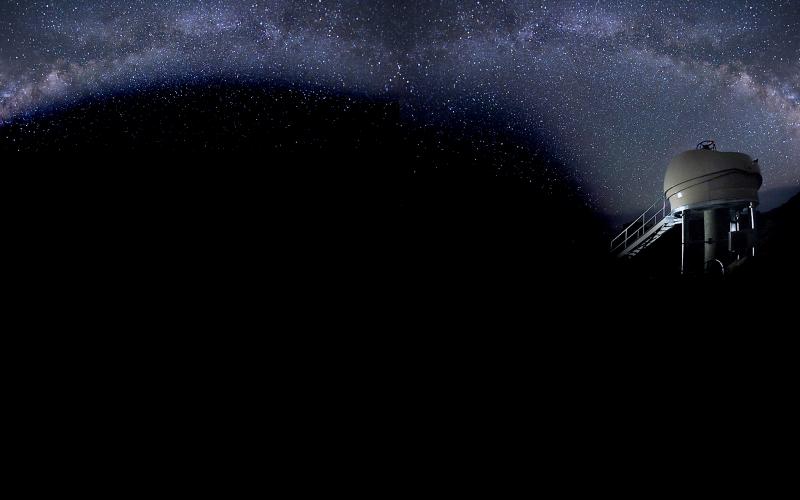
Hilburn is also the director of the Great Basin Observatory (GBO), a project of the Great Basin National Park Foundation and the only research-grade observatory located within a national park. At 6,825 feet (2,080 meters) in elevation, the observatory operates a 27.5-inch reflecting telescope, a spectrograph, and imaging equipment.

NASA resources and discoveries are vital to work conducted at GBO by helping direct researchers where to look, Hilburn noted. He and his students regularly utilize data from the Kepler and Transiting Exoplanet Survey Satellite (TESS) missions and from NASA’s Planetary Data System.
Conversely, observations made by smaller telescopes such as GBO’s also benefit NASA science. In one case, scientists working with the James Webb Space Telescope used data from a network of small telescopes to more accurately predict the transit of an exoplanet. As a result, they made more efficient use of the space telescope, reducing the necessary observation time from tens of minutes to a few minutes.
Preserving the dark remains vital to these science and educational activities and to the mission of Great Basin National Park. One way to inspire efforts to minimize light pollution is simply providing opportunities for people to witness the night sky. To show the value of the increasingly rare resource, Hilburn said, “you get people to come out and experience a dark night at the park.”
NASA Earth Observatory images by Wanmei Liang, using Landsat data from the U.S. Geological Survey and VIIRS day-night band data from the Suomi National Polar-orbiting Partnership. Photos by Paul Gardner. Story by Lindsey Doermann.